
You Shouldn't Have to Move to Get Good Care: LGBTQ+ Mental Health in Rural Areas
The assumption built into most LGBTQ+ mental health resources is that you live in or near a city. That you have access to queer bars and community centres and Pride events and a directory of affirming therapists. For many LGBTQ+ people, that assumption is wrong. Rural and small-town queer life has its own specific texture, its own challenges, its own forms of resilience, and its own mental health needs.
Outspace is built specifically to address the geographic access gap in LGBTQ+ affirming care.

The Specific Mental Health Challenges of Rural LGBTQ+ Life
Isolation and Lack of Community
One of the most consistently documented challenges for rural LGBTQ+ people is isolation. LGBTQ+ community spaces tend to be concentrated in urban areas. In rural environments, finding other LGBTQ+ people who are out, or finding spaces where you can be openly yourself, can be genuinely difficult. This isolation is not just socially unpleasant. It is a mental health risk factor. Community connection is one of the most powerful buffers against minority stress, and its absence compounds the effects of other stressors.
Visibility Without Safety
Rural environments often involve a particular dynamic around visibility. In a small community where everyone knows everyone, being LGBTQ+ is frequently more visible than in an anonymous urban environment, while the safety net of LGBTQ+ community and political visibility is often less present. This combination of high visibility and low safety infrastructure creates a specific kind of chronic stress. The sense that your queerness is known and observed but not supported or protected is different from being anonymous in a larger city.
Fewer Affirming Services
Research consistently documents that LGBTQ+ people in rural areas have access to fewer affirming mental health providers. Some rural areas have no affirming therapists within a reasonable distance. LGBTQ+ specific health centres, support groups, and community organisations are far less common outside urban areas. The result is that rural LGBTQ+ people who want affirming care often have to travel significant distances, accept non-affirming care, or go without.
Conservative Social and Religious Environments
Rural areas in the United States and many other countries tend toward more conservative social and religious norms around gender and sexuality. For LGBTQ+ people living in these environments, the ambient hostility, the casual homophobia of everyday conversation, the religious messaging, the absence of positive queer representation in community life, is a constant source of minority stress that is difficult to escape even when it does not take the form of explicit discrimination.
Economic Factors
Rural LGBTQ+ people are also more likely to face economic barriers to care. Rural economies often offer fewer employment options, lower wages, and less access to insurance coverage that includes mental health benefits. The financial barriers to accessing any mental health care, let alone affirming care, are often higher in rural areas.
What Helps: Strategies for Rural LGBTQ+ Mental Health
Telehealth Has Changed the Access Equation
One of the most significant developments for rural LGBTQ+ mental health in recent years is the expansion of telehealth. Online therapy with affirming practitioners is now available regardless of geographic location, and it removes the logistical barriers, the travel, and the privacy concerns that come with seeking care in a small community where a therapist's office might be noticed. Platforms like Outspace are specifically built for this: vetted, affirming therapists available online across locations.
Online LGBTQ+ Community
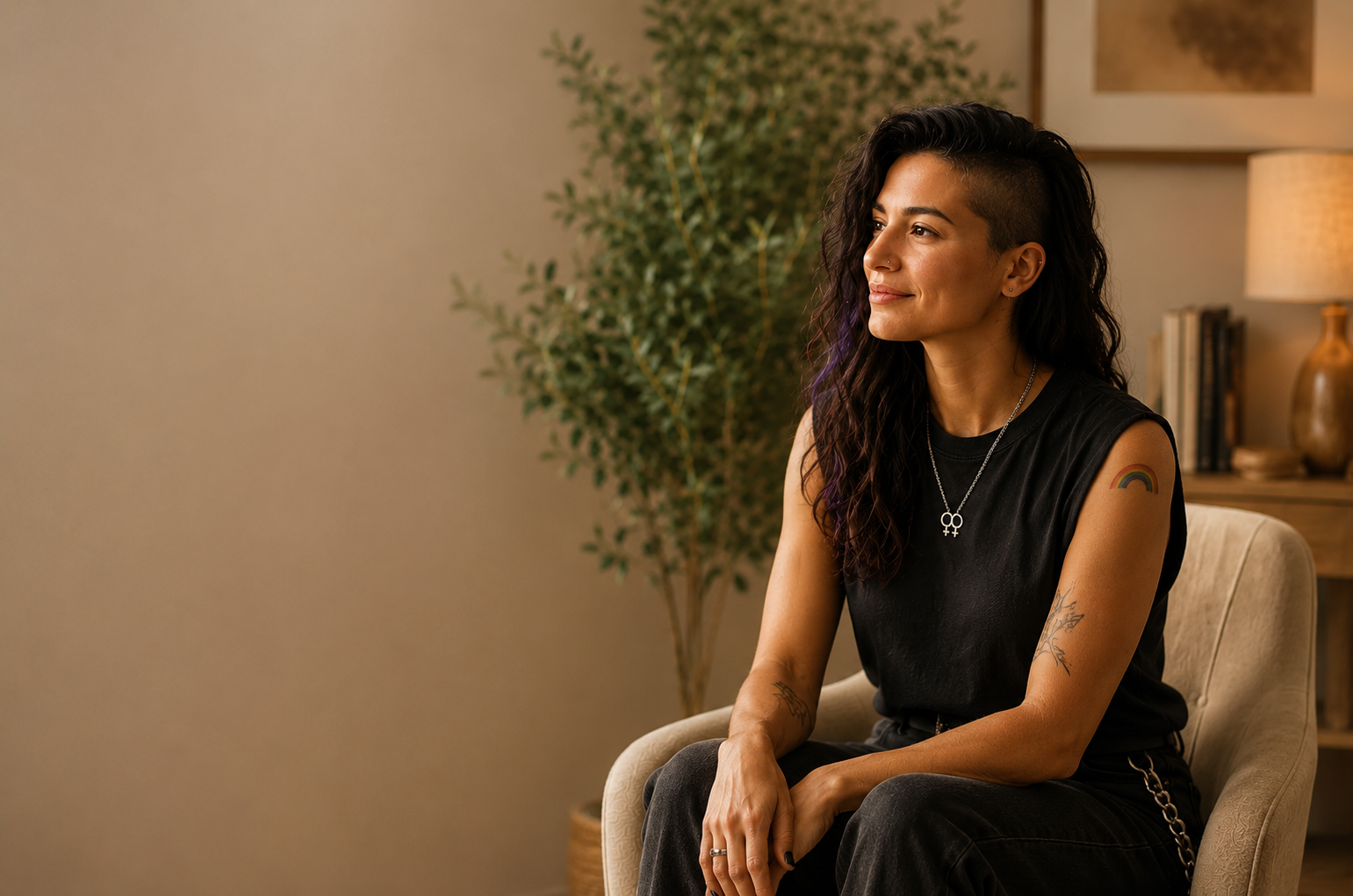
For people in areas without local LGBTQ+ community infrastructure, online community has become genuinely important. Online support groups, social communities, and affinity spaces allow rural LGBTQ+ people to access the community connection that research documents as protective, without requiring physical presence in urban areas. This does not replace local community, but it is meaningfully better than isolation.
Selective Outness as Strategy, Not Failure
In small communities where everyone knows everyone, being selectively out is often a rational safety strategy rather than a sign of shame or self-rejection. An affirming therapist will understand this distinction and will not push a client toward greater visibility than their environment safely supports. Managing outness strategically is not the same as internalised homophobia.
Building Pockets of Affirmation
Even in conservative rural environments, most LGBTQ+ people can identify at least a few spaces or relationships that offer genuine affirmation. Finding or building those pockets, the affirming friend, the welcoming faith community if relevant, the online group, the therapist who gets it, and investing deliberately in them provides meaningful protection against the cumulative toll of a less supportive wider environment.
The Trevor Project's Rural Youth Report documents the specific mental health landscape of rural LGBTQ+ young people and the protective factors that make the most difference.
The Bottom Line
Being LGBTQ+ in a rural or small-town environment is harder in specific documented ways: fewer services, less community, more ambient hostility, greater visibility without greater safety. That does not mean good mental health is out of reach. It means that accessing it requires a different set of strategies, and that affirming care specifically needs to be available regardless of geography.
Outspace provides online affirming therapy that does not require you to live in the right city to access good care.
Frequently Asked Questions
Is online therapy as effective as in-person therapy?
Research shows that online therapy is as effective as in-person therapy for most mental health concerns. For many people, the convenience and privacy of online therapy actually increases engagement and consistency.
I'm worried about privacy in my small community. How does online therapy help?
Online therapy removes the visibility of travelling to a therapist's office in a community where it might be noticed. Sessions happen from wherever you choose, with no one needing to know.
Are there LGBTQ+ communities online for rural queer people specifically?
Yes. There are online communities specifically for rural LGBTQ+ people, as well as general LGBTQ+ community spaces that are geographically accessible regardless of where you live.
I can't afford therapy. What are my options?
Ask about sliding scale fees. Some community mental health centres and LGBTQ+ organisations offer low-cost services. Online options can also be more affordable than in-person care.
Is being selectively out in my rural community a sign of shame?
No. Managing visibility based on real safety considerations is a rational strategy, not a failure of self-acceptance. An affirming therapist will understand this distinction.
What if there are no affirming therapists within driving distance?
Online therapy makes geographic distance largely irrelevant for mental health care. Outspace is specifically built to connect LGBTQ+ people with affirming therapists regardless of location.
