
What If the Loudest Voice Against You... Is Yours?
Most LGBTQ+ people have some experience of being judged, dismissed, or made to feel like something is wrong with them. What gets talked about less is what happens when those external messages stop coming from outside and start coming from inside. Internalized homophobia and transphobia are exactly that: the process by which years of social stigma get absorbed into how you see yourself.
The result is often subtle, usually painful, and not your fault. Understanding it is the first step toward healing it, and that's what Outspace supports every day.

What Are Internalized Homophobia and Transphobia?
Internalized homophobia is what happens when negative social messages about gay, lesbian, or bisexual identities get absorbed into a person's own self-concept. Internalized transphobia is the same process for trans and non-binary people. Together, they describe what researchers call internalised stigma — the integration of society's negative perceptions about LGBTQ+ identities into how a person sees and feels about themselves.
It doesn't happen overnight, and it doesn't happen because of any individual choice. It happens through exposure. Years of casual homophobia in the media, religious messaging that frames queerness as sinful, the absence of positive LGBTQ+ representation growing up, family reactions to anything that reads as "too gay" or "not the right gender" — all of this leaves a residue. And that residue shapes how people relate to their own identity, often without them realising it.
The particularly insidious thing about internalized stigma is that it doesn't announce itself. It tends to masquerade as personal truth. "I'm not like other queer people." "My identity is fine, I just don't need to make it such a big deal." "I find queer spaces uncomfortable." These thoughts can feel like genuine preferences or personality traits. But often, they're the residue of messages that told you your identity was shameful, and your mind found a way to agree before you could consciously choose to.
What It Looks Like in Real Life
Internalized homophobia and transphobia show up differently for different people, and they exist on a spectrum. Some signs are obvious. Many are subtle enough to go unnoticed for years.
In How You See Yourself
A persistent low-level sense of shame or wrongness about your identity, even when you can't point to a specific cause
Difficulty accepting affection, compliments, or love from partners, especially in contexts that feel visibly queer
A belief that your queer identity is something to manage or minimise rather than express
Discomfort when you are perceived as "too gay," "too trans," or otherwise visibly queer
Feelings of self-disgust or self-criticism that seem to activate specifically around your sexual orientation or gender identity
In Your Relationships
Difficulty being in relationships with people who are openly queer, because their visibility triggers your own shame
Preferring partners who can pass as straight or cisgender, in ways that go beyond practical safety considerations
Struggling to feel that your relationship is fully real or legitimate, even when you consciously know it is
Jealousy or resentment toward queer people who seem comfortable in their identity, when you haven't been able to get there yet
In Your Behaviour
Avoiding LGBTQ+ spaces, events, or media because of a vague but persistent discomfort
Making self-deprecating jokes about your own queerness that come from a real place of discomfort
Performing heteronormativity in ways that go beyond practical safety — presenting straight or cisgender in situations where it isn't necessary
Feeling compelled to prove you're "one of the good ones" — not political, not flamboyant, not making a fuss
None of these things make you a bad person or a poor advocate for LGBTQ+ people. They make you someone who absorbed a set of messages from their environment and is still working to unlearn them. That's not a moral failing. It's a deeply human response to a deeply unfair set of pressures.

Where It Comes From
Understanding the origins of internalized homophobia and transphobia isn't about blame — it's about clarity. When you understand where something came from, it stops feeling like the truth and starts feeling like what it actually is: a learned response.
Religion and Cultural Messaging
For many LGBTQ+ people, religious environments were the primary context in which they first encountered the message that their identity was wrong. This doesn't require explicit condemnation — sometimes it was simply the absence of any positive representation, or the implicit assumption that everyone is straight and cisgender. For people raised in communities where LGBTQ+ identities are actively condemned, the impact tends to be deeper and more difficult to untangle. The message got in early, through people and institutions the person trusted, and it carries the weight of that trust.
Family Responses
How a family responds to LGBTQ+ identity — directly or indirectly — is one of the most powerful shapers of internalized stigma. This includes explicit rejection, but also subtler patterns: the parent who changes the subject when anything queer comes up on TV, the extended family whose affection feels conditional, the sibling who uses "gay" as an insult. Children absorb the emotional atmosphere of their family long before they have language for it. Those early emotional lessons are often the most deeply entrenched.
Media, Culture, and Representation
Growing up without positive LGBTQ+ representation, or with representation that was stereotyped, tragic, or played for laughs, shapes what feels possible and normal. When the only queer characters you saw were punchlines or storylines about suffering, that leaves a mark. The recent increase in genuine, varied LGBTQ+ representation in media matters precisely because of how much its absence mattered to generations before it.
The Political and Legislative Climate
The current surge in anti-LGBTQ+ legislation isn't just a political concern. Research documents how persistent social exclusion and legislative targeting actively reinforce internalized stigma in LGBTQ+ individuals. When institutions treat queerness as something to be restricted or controlled, that sends a message to queer people about how the world sees them — and some of those people start to see themselves the same way.
Why It Matters: The Mental Health Impact
Internalized homophobia and transphobia have real, documented effects on mental and physical health. Research consistently links internalised stigma to higher rates of depression, anxiety, and suicidal ideation in LGBTQ+ people. It's associated with lower relationship quality and satisfaction in same-sex couples. It predicts patterns of self-concealment that compound over time. And it interferes with the ability to access community and support — the very things that buffer against minority stress. The Trevor Project's guide on self-acceptance summarises it clearly: studies show a direct correlation between internalized homophobia and transphobia and negative mental health outcomes.
It's also worth naming something that often gets missed: internalized stigma doesn't only affect people who are still in the closet or new to their identity. Many people who have been out for years, who have strong queer community, who advocate loudly for LGBTQ+ rights, still carry pockets of internalized shame they haven't fully examined. Coming out doesn't automatically clear the residue. That work is often separate and ongoing.
"Internalized beliefs are learned — and they can be unlearned." — Trevor Project
How Therapy Helps
Therapy isn't the only path to healing internalized homophobia and transphobia, but for many people it's one of the most effective — because it creates a structured, consistent space to do the kind of inner work that's hard to sustain alone.
The key word is affirming. Therapy with someone who doesn't fully understand LGBTQ+ experience can inadvertently reinforce internalized stigma rather than address it. A therapist who treats your queerness as incidental, or who operates from heteronormative assumptions, isn't equipped for this work. What you need is someone who understands internalised stigma specifically, who can name it when it shows up in session, and who creates enough safety for you to examine beliefs you've probably been living inside for years.
Affirmative Cognitive Behavioural Therapy
Affirmative CBT is one of the most well-evidenced approaches for working with internalized homophobia and transphobia. It works by helping you identify specific thought patterns — the beliefs about yourself that feel like facts but are actually learned conclusions — and examining whether they hold up when you look at them directly. The goal isn't to think positively for its own sake. It's to replace distorted, shame-based thinking with more accurate, compassionate self-perception.
Acceptance and Commitment Therapy
ACT takes a slightly different angle. Rather than directly challenging negative thoughts, it focuses on psychological flexibility — learning to hold difficult feelings without being controlled by them, and committing to values-based action regardless. Research on ACT with LGBTQ+ individuals found it helps buffer minority stress and reduce symptoms across a range of mental health challenges. For people dealing with deeply entrenched shame, the ACT framing of "I can hold this feeling without it defining me" can be particularly liberating.
Narrative and Identity Work
Many people find that the most transformative part of therapy is simply being given space to tell their own story — to trace where their self-critical beliefs came from, identify the moments they were installed, and start to author a different account of who they are. Sometimes it's just the experience of speaking honestly about your inner life to someone who responds with curiosity rather than judgment.
Community as Part of Healing
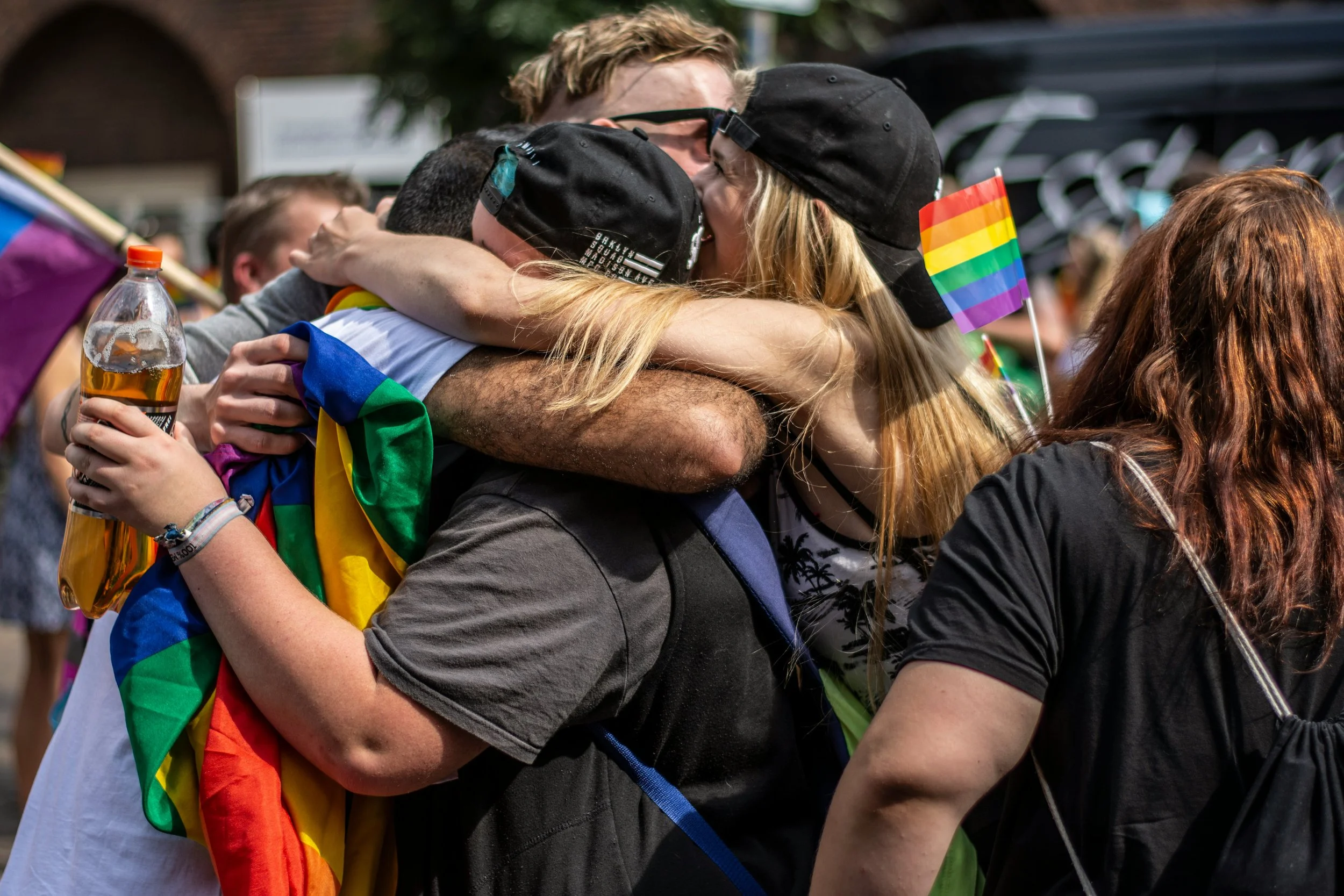
Therapy works best in combination with community. Spending time with other LGBTQ+ people who are comfortable in their identities can do something therapy alone can't: it provides living evidence that the shame is wrong. Seeing people who love like you and move through the world with ease and joy is a form of counter-programming. Community is genuinely therapeutic.
Practical Starting Points
You don't need to be in therapy to start working on this. There are things you can do right now that create conditions for healing.
Name it. When you notice a moment of self-disgust or a reflexive wish to be less visibly queer, try naming it as internalized stigma rather than fact. "That's not my truth. That's something I was taught."
Audit your media. Seek out content that shows queer lives in their full complexity and joy, not just their struggles.
Spend time in affirming community. Find spaces, online or in person, where your queerness is a given rather than a variable. The normalising effect is real.
Be patient with non-linearity. Healing from internalized stigma is not a straight line. You'll have breakthroughs and then feel like you've gone backwards. That's normal.
Notice self-criticism that activates specifically around identity. When the inner critic gets loudest in relation to your queerness, that's the material to work with.
The Bottom Line
Internalized homophobia and transphobia are the long shadow of growing up in a world that didn't fully welcome who you are. They're not a personal weakness, and they're not evidence that your identity is actually problematic. They're the predictable result of absorbing messages from environments that didn't know better, or that actively chose to cause harm.
The good news is that what was learned can be unlearned. It takes time, and it usually takes support. But the work of healing from internalized shame — of getting to a place where your inner voice sounds more like an ally than a critic — is some of the most meaningful work there is.
Outspace works with LGBTQ+ people at every stage of this journey. Whether you're just beginning to recognise internalized stigma in yourself, or you've been working on it for years, our affirming therapists are here.

Frequently Asked Questions
How do I know if what I'm feeling is internalized homophobia or just personal preference?
The distinction often lies in where the feeling comes from. A genuine preference tends to feel neutral. Internalized stigma tends to come with a background hum of shame or self-criticism. Therapy can give you the space to work out which is which.
Can someone who is out and confident still have internalized homophobia?
Absolutely. Being out, confident, or politically active doesn't automatically clear the residue of early messages. It often shows up in specific contexts, in how someone relates to certain kinds of visibility or in their closest relationships.
Is it possible to fully heal from internalized homophobia and transphobia?
Most people describe it as a gradual shift rather than a complete cure. The beliefs lose their power, the self-criticism becomes less automatic, and the shame gets quieter. That's real, meaningful change.
My partner seems to have a lot of internalized shame. How can I support them?
Consistency and patience tend to help most. Affirm their identity without pressure. Create space for honest conversation. And gently encourage professional support if they seem to be struggling — not as a judgment, but as care.
I grew up in a religious household and my faith is still important to me. Can I work through internalized shame without leaving my religion?
Yes. Many LGBTQ+ people navigate faith and queer identity simultaneously, and affirming therapy can hold that complexity. The goal isn't to make you choose — it's to help you find a relationship with both that doesn't require you to harm yourself.
I keep hitting the same walls working on this alone. Do I actually need therapy?
When you keep hitting the same walls alone, it's usually a sign the work needs a different kind of container. Internalized stigma often runs deep, installed before we had the capacity to interrogate it. A therapist who understands this specific territory can help you access material that's genuinely hard to reach on your own.
